Designing the covers

One thing me and Jenný have in common with our parents is that we tend to talk about our work a lot. As a result we know way too much about linguistics and journalism (our mother’s fields) and psychology (which is what dad does).

It also means that we are very much aware of each others tastes and priorities when it comes to design, writing, and illustration. And one particular taste we share is a dislike – bordering on grumpy annoyance – of typical fantasy and science fiction covers. Those covers generally fall into two categories, with very few exceptions:

  • A photorealistic painting of pretty people in poses, often in some state of undress.
  • A photorealistic painting of a big impressive thing: spaceship, dragon, sword.

Both are very very common and very very boring.

Now the original inception of the Knights and Necromancers series was based on a highly stylised etching of three ravens that my sister made more than a decade ago (I’ll write a blog post about that one of these days) so a logical thing to do would have been to base the styles of the covers on that print.

But that wasn’t the effect I wanted.


I wanted the covers to do two things:

  • Be entirely unlike a typical fantasy cover.
  • At the same time work as a fantasy cover.

One approach would have been to take the approach Penguin did in the sixties and seventies with cover designs based on a tight grid and often abstract images.

But I wanted a cover that implied a sort of sketchy roughness. I wanted it to be as rough and loose as the typical fantasy cover is realistic and detailed.

Jenný came up with the idea of charcoal on textured paper and after she’d done the first illustration it was clear that she had understood even better than I did exactly what it was that I wanted.

So I then gave her a list of what I wanted on the other covers along with reference photos. She generally ended up ignoring the references, except for the worm on the cover of book number three, which I think she completed in record time, after which she felt icky for days. (Like most Icelanders, she doesn’t like bugs, so drawing one was a bit of an ordeal.)


One particular thing has come up time and again as me and my sister have been working on Heartpunk and other Studio Tendra projects is that most people really don’t get why everything takes so much time.

Obviously, a lot of the lead time in big(ger) publishing is due to artefacts of their chosen process, many of which are not really applicable to an ebook-only outfit, but even that leaves out the one big reason why long lead times are actually a good idea when possible.

Namely, a longer lead time increases quality, more so than anything else you can do. Even without involving other people, freelancers, staff, or money, taking a little bit more time to think (or not to think, to get a bit of distance) is the one major thing you can do that will drastically improve the quality of your work.

Nothing improves a blog post more than letting it rest for a night before you publish.

And when you’re working on something more substantial, giving a work a few week’s distance between iterations can be the difference between a half-baked plot full of warped and broken sentences and something more solid.

(For example, the first draft of Knights and Necromancers 1: Days of wild obedience was completed over two years ago.)

The same applies to covers.

After Jenný had completed the initial illustrations it was my turn to figure out how to turn those illustrations into covers.

That’s where time comes into the picture. It went something like this:

I do a test design of a cover, which everybody in our informal feedback group likes, but to which I always say “eh, I don’t know’. I wait a few days and do another iteration, which everybody likes, but to which I say “eh, I don’t know’.

Then I do another—well, you can see where this is going. The League Gothic for the titles was the biggest surprise of all. I’m generally not that fond of it but it just clicked in place when I tried it for the main title. The aspect ratio was another surprise. I’d always envisioned much narrower covers but the overall style just didn’t feel right until I made them wider.


At this point, Studio Tendra has done eleven covers: the six books of the Knights and Necromancers series, four books in a series of annotated public domain books (which I’ll tell you all about in a few weeks’ time), and one in an aborted project you probably will never hear anything more about.

(So, yeah, we’ve got a pipeline of stuff to publish that’ll last us well into 2013.)

Jenný’s taken on more and more of the layout and design part of the cover creation process. The covers of our next project are almost entirely her work where there’s not much left for me to do except to make sure that there are no typos in the text.

And a few days ago we finished the last two covers in the Knights and Necromancers series. I haven’t added them to the Heartpunk website yet, but here’s a preview for the impatient among you.

Click to embiggen:
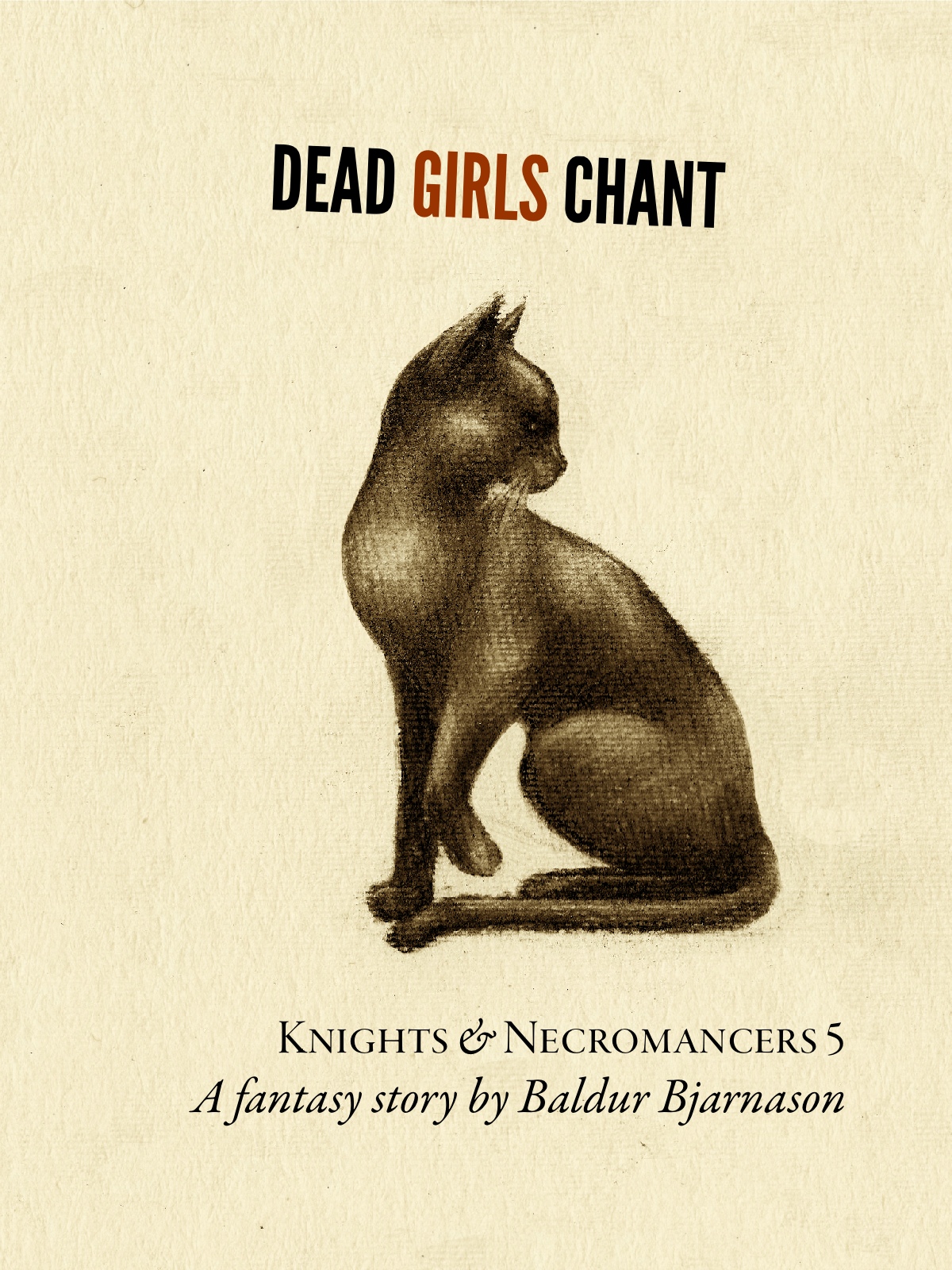
The cover of the fifth book in the Knights an Necromancers series, a charcoal sketch of a cat

Book number five

Knights and Necromancers 6

Book number six


And all of the book covers in a nice gallery thing:

Free Kindle version

Giving away the first book in a series is a good idea, right? Right?

One fun fact people tend to forget is that Amazon puts a price floor on all self-published ebooks: they can’t cost less than $0.99 unless they come from a distributor (like Smashwords) or are being price matched with other retailers that do allow free books.

Of course, I’d hoped that Amazon would have match the price of the Kobo and iBooks editions by now, but since they haven’t I’m going to post free mobi versions of the first book here. I don’t think most people mind the 99 cents but any obstacle is an obstacle too much.

This is something I should have done Monday but there you are.

You can read more about the first book on the page for Knights and Necromancers 1: Days of wild obedience and more about what this project is in Monday’s blog post.

I’ve separated the Mobi7 and KF8 versions to cut down on the file size. Pick the one most suited to your purposes.

Needless to say, I have no idea how to help you if you run into problems with how to load these files onto your Kindle. 🙂

What is this?

This is the home to a series of publishing experiments. Me (Baldur) and my sister (Jenný) have joined forces in making books we hope you will find interesting.
The cover to Knights and Necromancers 1

Knights and Necromancers 1: Days of wild obedience

Some of you may know us from the work we’ve done separately. I’ve been heavily involved in ebook discussion, production and research. My sister has been painting and illustrating children’s books in Iceland. We’ve been planning for a long time to do some projects together.

The first of these experiments is Heartpunk, specifically a series of six novellas called Knights and Necromancers. Jenný does the covers. I do the text, ebook design, and web stuff. It’s fiction. Pulp-ish sword and sorcery. Should be fun.

After that we’re working on a series of annotated public domain books. Which should, hopefully, also be fun.


There are a few common threads that seem to run through most self-publishing projects. Most of the conversations are dominated by a limited palette of voices.

Some sit in near total silence, push out their books without any notice, almost as if the writer was embarrassed by what they’re doing or is so fearful of failure that they try everything they can not to draw attention. They’re then incredibly surprised at whatever it is that happens after that, success or failure.

Some are blatantly delusional, out to conquer the world, revolutionaries railing against the publishing world.

Some have dropped out of the more traditional publishing world, for whatever reason, and use self-publishing as a reason to rant about the world they’ve left, much like an divorcee dropping into a rant about ‘the new husband’ in the middle of a conversation on baked beans on toast (with cheese, or without).

Most of the time, discussions on self-publishing use it as a proxy for whatever hangups the discussers have about… well, anything. The actual subject can be as wide-ranging as health insurance, capitalism, networking, and grammar but people constantly make a mockery of these worthwhile subjects by masking them as discussions on self-publishing. In the same way, nobody ever actually talks about DRM but use it as a proxy for ‘piracy’ or ‘sharing’ (if they did actually discuss DRM, they’d be agin’ it, because its lack of ROI is empirically measurable in and of itself, for better or for worse, we live in a capitalist society that only does things that don’t have a provable ROI when overridden by ideology, religion, or sex, so any supporter of DRM is a bad, bad, capitalist). Self-publishing isn’t a subject but a shibboleth where the responses are used to categorise, brand, and segregate people into various camps depending on what the actual underlying subject is at the time.

As it turns out, if you do your research, a lot of self-publishers don’t talk about self-publishing at all. They talk about books, stories, ideas, aesthetics, design, genres, people—stuff that’s, y’know, actually fun. They are artists. They have a craft. And the craft is the only thing that matters.


Upton Sinclair liked to say that “it is difficult to get a man to understand something, when his salary depends upon his not understanding it”.

The problem with that quote is that it’s a glib way of dismissing the cognitive dissonance people experience when the conditions and context of their employment contradict the facts of the matter. People are very good at rationalising their actions and so become exceptional at figuring out reasons why this or that uncomfortable fact doesn’t really apply to them, just to others, or how that uncomfortable fact isn’t actually a fact because the presenter of said fact isn’t from within the industry and so doesn’t know better.

If you only do work in one part of a chain, the limited view you have of the overall field begins to – in your mind – define the entire field. The programmer thinks about the entire industry in terms of code, the web worker in terms of the web, the marketer in terms of promotion and marketing, and the designer in terms of visuals. Pars pro toto. Nobody is thinking holistically about what problem the company is solving for the customer.

Self-publishing is a chance to do exactly that: think holistically about what problem it is that publishing solves.


One of the big mistakes pundits make is in trying to understand self-publishing in the same terms as they understand larger publishing. They aren’t the same beast at all. Not even of the same genus. They solve the same problem for the reader but do so by generally different means. They are fundamentally different species.

Self-publishing is a craft, an art of workmanship where a single individual takes responsibility of every aspect of the product. It is to publishing what woodworking is to Ikea. As a craft, its output is considerably more varied and, well, odder than what you get from the multi-stage, multi-employee, pipeline that is modern publishing. As a craft, its output is a truer representation of the author’s personality than a polished bestseller from the big six.

Buying handmade furniture isn’t a practical decision. For almost any scenario you can imagine, a mass produced Kaustby chair is going to be more practical than a handmade one. Especially when, as is going to happen sometimes, the handmade chair is made by a newly started craftsman still full of the glee and arrogance of an inexperienced beginner. Unless you’ve lucked on an experienced woodworker, Ikea’s Kaustby chair is likely to last longer, creak less, and hold more weight. It even comes in three colours. All for much less than the handmade one made by Steve in his garage.

The Ikea chair is almost completely devoid of personality, of course, and mass-producing character is trickier than people let on. Personality and character do happen to be things that a lot of people value in the creative works they consume. That’s one advantage self-publishing has that woodworking doesn’t.

As with indie games, the role self-published ebooks serve in the market is to provide readers with oddball stories they would never find elsewhere. Their purpose is to be unique and individualistic—the idiosyncratic expression of one mind. They’re there to make the books big publishing wouldn’t even dream about. Hopefully, one day my work will rise to the level of being able to incite as much what-the-hell? curiosity as a game where you play an octopus trying to pass as a newly married human father of two. All self-publishers should be so ambitious. 🙂


As a self-publishing project, Heartpunk isn’t going to be about self-publishing in any way shape or form. I don’t expect to comment on self-publishing on this blog at all. (I’ll do that in other venues.) Heartpunk will be about fantasy, sword and sorcery, noir, gender and social issues, aesthetics and design, and all sorts of fun stuff.

The first six stories we’re doing are a sword and sorcery series, Knights and Necromancers, set in a world called Alaentera. It’s already completed, covers and all, and the stories will be published over the next six to eight months or so. I haven’t quite decided on the exact schedule yet.

You can download the first ebook for free on the Knights and Necromancers 1: Days of wild obedience page and, if you like it, you might want to join the mailing list to get a notification email when the next one comes out.

The first book is live on Amazon.com, Amazon.co.uk, Kobo, and iBooks. The Kindle books cost $0.99 because KDP doesn’t let you set the price to zero. Hopefully, Amazon will soon notice that the book is free elsewhere and drop the price to zero.

Let me know what you think.


ETA: I’ve uploaded free MOBI and KF8 versions of the first book for those who don’t feel like spending $0.99.