Ebook silos, update

Yesterday, I wrote a post on ebook silos and missed opportunities.

Some people seem to be missing the core criticism in the post. The problem, as I see it, is in the infrastructure and in the market we have in place. This is not a lament for how lazy people must be or how stupid existing developers are for not implementing these things already.

Existing ebook reading apps are bland out of necessity. The ones implemented by silo owners need to appeal to and be useful to everybody. They can’t not be generic. Specialisation is not an option when you need to appeal to the lowest common denominator.

The independents have a different problem. They need to both implement detailed support overly complex file formats and they need to target one of the silos (generally Adobe’s playground, which is a fraction of the overall market).

Because the market involved is so small and the end result is that their apps have to have broad appeal. A specialised app targeting a fraction of a fraction of a market is not economically viable when you are employing a team of developers.

The solution to this conundrum is both simple and difficult (like so many simple things are).

Generally speaking, the way to promote variety in any given software genre is to make sure that it’s possible for a solo developer or a small team of developers to create and maintain an app in the genre. Only a solo developer (maybe a duo) can hope to make a living by addressing a fraction of a fraction of a market.

I’m convinced that, if a solo developer found a way to implement one a specialised ereader that was useful and valuable to readers, they’d be able to make a decent living from said app.

One such example is Marvin. It’s an ereading app that focuses on configurability, text analysis, Dropbox support, proper annotations export, and a lot lot more. It is quite different from most other ebook reading apps in the market and is quite excellent. It’s not for everybody, but it is unique enough for there to be a large group of people who both have been waiting for an app like this and are eager enough to use it that they are willing to break the DRM on their existing library to use it.

Anybody who is in any way dissatisfied with their current ebook reading app owes it to themselves to try it out.

Which brings me to the compromises needed to make the byzantine mess that are ebook file formats manageable by a small team. Marvin offers a few pointers in that direction:

  • No DRM support.
  • Only EPUB 2.0 support to begin with.
  • Limited support for ebook design and styling, which is okay for a small app because all of its users opt in to no styling. They know what they are getting.
  • No support for video or audio.
  • No FXL support.
  • No PDF support.
  • No attempt to achieve full spec coverage but instead a laser-like focus on implementing features that crop up in customer feedback.

Now, Marvin owes a bit of its success to luck, but I still think it offers us hope for how things could go in the future. Solo developers and small teams will experiment with apps. Some will fail. Some will succeed.


—Couldn’t Readium SDK help?

Possibly, but that’s not what it’s for. As I see it, the primary goal of the Readium SDK is to get large corporations who are competitors to collaborate on improving their support for the various incredibly complex flavours of EPUB (2, 3, FXL). This is hard enough without trying to address the needs of solo developers as well.

The cost of acquiring a license usable in a commercial product bears this out. After September you need to pay $60 000 to join and get a license or you need to contribute work and source code. Both are going to be way beyond the means of a solo developer attempting the already difficult and risky task of a specialised ebook reading app.

And that’s okay. Readium SDK has an already unenviable goal (achieve full format support in all major big-corp generic readers). Maybe once that’s achieved and all major apps have shipped with full EPUB3 support, maybe then the foundation will reassess the licensing terms. Before then they are more than justified in focusing on trying to solve the problem they set out to solve.


—What would really help?

More publishers going DRM-free would help a lot, especially those catering to less price-sensitive specialist subjects. That would open up the market for a developer to enter with a specialised app catering to those readers.

In fact, O’Reilly’s pioneering work with DRM-free might well be an opportunity for a developer-oriented ebook reading app, one with built in REPLs and consoles for various languages. Imagine being able to run and play with example code in a variety of common languages from a dev ebook just with a tap. Imagine having access to each platform’s documentation as you read a book on a specific problem area; having access to the official documentation for a method with just a tap.

More comics publishers following the example of Image Comics (they sell DRM-free comics direct, not enough of them yet, but it’s a start) or Thrillbent might open up the field for a specialised comics-oriented ebook reader, one that only supports FXL ebooks and PDFs. They might even be justified in only supporting PDFs and CBRs.


I’m convinced you don’t need full EPUB3 or DRM support to create an excellent app that is sufficiently useful to enough people to be a viable business for a tiny team.

The app would have to be specialised and solve very specific problems for very specific group of people with very specific needs. Just making an ebook reader with cool and unusual features isn’t going to work again, even if it did work for Marvin. You need to both delight and remove pain. Delight alone will not do.

I’m not saying it would be easy. It’s clearly a difficult problem. But it would be interesting.

Ebook silos and missed opportunities

ETA: I’ve posted a followup to this post that hopefully clarifies things and offers a few suggestions: Ebook silos, update.


Ebooks can be transformed by context. Print books cannot. No matter where you take the print book, no matter what room you read it in, it will remain in the same form and have the same affordances as it did on the day it was first stacked in the bookstore.

An ebook could, in theory, be reformed, rebound, and recast at will. A writer who is reading for research could open it in an ereader specifically designed to enable writing and integrates directly with writing tools. A student could use a specialised ereader that is full of mnemonic tools, structured note-taking, and export functions that integrate with common reference management software. A genre fiction reader might use an app that stamps all ebooks into the same aesthetic template, configured by the reader into the form they consider ideal.

It’s easy to imagine how these would work:

The writer’s ereader wouldn’t atomise the reader’s annotations but would present the annotations for a book as a single, freeform, document that could be edited, extended, filled with notes and exported in formats compatible with common writing tools (Word, Scrivener, etc.). Every set of annotations would be a commonplace book in machine-readable form. Bonus points for automatically syncing to Evernote and Dropbox.

The student’s ereader would integrate directly with Endnote and offer mnemonic features such as regular pauses for recollection, forcing the reader to note down what they thought the preceding pages were about (research shows that if you stop, close the book, and try to recollect what the preceding pages were about your recall will subsequently be improved). There’s a lot of research on learning styles and tools that would be a goldmine for this sort of UI experimentation.

Then there’s the potential for a specialised comics app. Fixed layout formats require dramatically different UIs for optimal treatment of annotations, clipping, highlighting, and browsing. It’s easy to imagine a comics ereader that makes it easy to clip and visually annotate sections from the comic book. It’s also easy to an app that specialises in the format would offer a much better experience than the schizophrenic status quo.

The genre reading app does not have to limit itself to design configurability. A reading app for crime and mystery stories could integrate an extensive database of firearms, poisons, historical crimes, police terminology, and common codes for crimes.

That’s without getting into the various features that nobody offers because everybody’s trying to be the same:

  • Scrolling instead of pagination. I’d jump on a well-implemented scrolling ebook reading app (iBook’s jerky crap is not it).
  • Autoplay/autoscrolling. Sometimes you want to force yourself to keep a reading pace.
  • In-text annotations. Sometimes I want to edit the actual ebook itself.
  • Dropbox syncing for my library and annotations.

None of these features require new standards or extensions to old ones. They could work with plain text if you wanted.

An app that is everything to everybody is bland. Generic is dull. Specialisation creates immense value.

But instead of specialisation and diversification among ereaders we see convergence. Ebook reading app become more similar with every release. They all aim to support the same rendering features, in roughly the same way (infuriating differences in style overrides notwithstanding), surrounded by the same constellation of widgets and tools.

  • Highlights? Check.
  • Highlights made more ‘natural’ by behaving like a highlighter? Check.
  • Notes? Check.
  • Notes mades social in some way, via sharing or a dedicated service? Check.
  • Highlights that lose all formatting whenever they are moved into another context? Check.
  • Offer a selection of four to five fonts (plus the ever present ‘publisher defaults’)? Check.
  • Sync all of this bland crap using a proprietary syncing service allowing no other alternatives.
  • Limit the export of all of this bland crap to something even blander and more useless than what you already offer like text-in-body email.
  • A neato brightness UI that makes people swoon because their Stockholm syndrome has lowered their expectations so far that they have to look up to see the bottom of the Mariana Trench.

Check. Check. Check. Any ebook reading app that doesn’t behave like this is aiming to. This is the ‘ideal’ they all seem to be striving towards and when pressed for answers on why they don’t try to solve hard problems (like proper annotations export), the only reply is that the standards for those hard problems aren’t there yet.

And they will never be there because the best standards are those that standardise existing best practice. Nobody offers proper annotations export and so there is nothing to standardise.

But just focusing on the individual features is the wrong way to look at the problem.

Which, obviously, is silos. You’re locked into the ecosystem you bought the ebook from. Nobody will ever create a specialised Kindle ebook reading app for writers or for students. There will never be much variety in how ebook reading apps based on Adobe’s RMSDK behave. The only app that will ever work with ebooks bought from the iBookstore is iBooks.

The one major and unique strength that ebooks have over print, flexibility and fluidity, the characteristic that has the biggest potential for adding value, has been thoroughly walled away by the silo mentality. Ebooks could have been a transformative sea change in how we read books but instead are nothing more than a second-rate alternative to cheap paperbacks.

What you people read (on my websites)

One of the basic problems with website ‘analytics’ is that a lot of the data is just noise. We have no real insight into cause and effect—that traffic sources section is insidious because it often amounts to little more than misdirection, knowing where people come from almost never tells you why they came.

The scary and frightening fact is that the effectiveness of our online marketing and traffic generation tactics is probably due to random chance—spending time on a particular source of traffic is no different from just buying more lottery tickets. Sure, you’ve increased your chances, but its success is still just down to random chance.

Or, even when something you do does have a significant effect, it might just be the novelty effect. It’s not what you did that mattered, just that it was new.

That said, when you have a statistically significant difference over a lengthy period of time, you probably have a piece of data there you can count on.

For example, it’s pretty certain that most of you lot only read my ebook publishing, production, and analysis posts. If we discount the statistical anomalies (like my posts debunking a few myths on the Icelandic political situation which are the most popular pieces I’ve ever written, unfortunately) an ebook post tends to get more than ten times more traffic than a post on any other subject published at a roughly similar time of day and day of week.

Now, drawing any conclusions from this is risky. Ebooks are the subject that I’ve covered rather consistently throughout my career and they are my subject of expertise, so it makes sense that other subjects haven’t attracted a regular audience.

Still, I always find it a little bit disappointing that the popularity of my blog posts is inversely proportional to how much fun I had writing them.

If the Kindle fails so will ebooks

I don’t get why anti-Amazon people get up in arms whenever they find an author who links to the Amazon pages for their books. Or whenever a publisher out there seems to favour the Seattle Behemoth over the ‘honourable’ opposition.

I get why people don’t like Amazon. They are a big, competitive, ruthless, anti-union tax avoider that treats low level staff (like, say, warehouse employees) like slave labour. There’s a lot not to like.

What I don’t understand is what do people expect us to do?

Even if every publisher, every author, and every editor out there studiously avoided sending traffic to Amazon in any way, that wouldn’t even cause a measurable dent in Amazon’s book or ebook revenue.

People go to Amazon, they aren’t sent there.

Pointing people anywhere else will only result in lower affiliate fees for the author or publisher as people follow the link, close the tab, and then go to Amazon directly to buy it there anyway.

The only thing the publishing industry can do to harm Amazon is not to sell their titles there, and even then, unless they are colluding illegally to withdraw their products from Amazon all at the same time, that action is more likely to harm the publisher than Amazon.

Hoping for Amazon to collapse or fail is equally self-destructive. There are few things more dangerous to a publisher than having a big retailer or distributor go bust on them. It locks up inventory and money for a long time and usually result in the market shrinking in the short term.

Moreover, I’m pretty sure the fate of ebooks is intertwined with the fate of the Kindle.


The only ways Amazon can be beaten by a ebook competitor is if a competitor:

  • Focuses on a genre and on being the best store for that genre. Take the niche not the market.
  • Consistently outperforms Amazon and slowly takes market share over, say, a decade. This will take years and the ebook market will probably be disrupted by something else by the time they’re done, anyway.
  • Be the first. This is Kobo’s tactic and it isn’t wrong. Amazon hasn’t rolled out in all territories yet so there is potential for being there first in a lot of countries and be the incumbent once Amazon arrives. The only downside is that Amazon is in all of the lucrative territories already.
  • Collude and manipulate the market illegally. That’s what publishers have basically been doing so far, managing to push Amazon down a bit but they haven’t made much of a headway lately.
  • Finally, you can hope that Amazon makes some sort of misstep that leads to a collapse or deterioration in performance leaving space for others to step in.

This last possibility, at first glance, seems like it would be the ideal scenario for Amazon’s competitors.

The problem is that ebooks are the Kindle and Amazon as far as most buyers are concerned. Most of those buyers have non-book alternatives competing for their entertainment dollars as well. If Amazon had a major misstep, that would be more likely to result in the ebook market contracting than in somebody else taking over.


Here’s a thought exercise. Let’s imagine that we could magically retcon the ebook market so that it was now evenly split between all five major aspirants (Amazon, Kobo, B&N, Apple, Google).

You might haggle about who the runners up should be but most would go with those five.

What do you think would happen tomorrow? What would happen the day after the retcon when our magical reality-bending powers faded and the personalities and capabilities of those employed at each retailer took over again?

Over the next couple of years Amazon would retake its marketshare until it owned at least 60% of the ebook market again. Why? Because it would build on its ecommerce expertise in general (they don’t just do ebooks), because it has better customer service than the others, and because it would have lower prices. Amazon will always have lower prices because it is willing to aggressively give up revenue to do so and its executives passionately believe that it’s the right tactic for them. Other companies don’t have the guts to match it completely.

No two ways about it. Amazon has earned its marketshare.

That doesn’t mean that, taken as a whole, Amazon isn’t manipulative and utterly ruthless. They are. And they have a frightening amount of resources. That’s why they’d retake the market in record time.

So, how do you beat Amazon? You don’t. You can’t beat a tiger at being a tiger. If you are afraid of a tiger, the only sensible strategy is to avoid it.

Stop selling books through Amazon. Raise your prices and sell direct, making sure to provide a world class service. But you’d have to make damn sure that your books are interesting because otherwise none of your readers will bother.

This ebook is a lemon

It’s no secret that I’m a huge fan of both Akerlof and Romer, not just the paper they co-wrote on looting in the financial system but also their work individually. Turns out one of Akerlof’s most famous papers is directly relevant to the ebook market.

For starters, a few basic premises. If you disagree with any one of these you can feel free to ignore the entire argument. I can easily pick apart any one of these statements myself, so I’d understand it very well if you disagreed with them. However, if you find them somewhat likely then the overall picture of the ebook market is a bit dark.

  • Ebook buyers buy more than they read. Book abandonment is high and out of proportion with the return rate.
  • Sampling the first few chapters is a lousy predictor of how much the reader will enjoy the book. You can only assess basic stylistic issues from a sample, not storytelling quality. Ergo the reader has to buy the ebook to assess the quality of the story.
  • Reviews are an extremely unreliable indicator of quality. The average quality of most reviews themselves is very low. Many reviewers are paid shills or just extremely overworked.
  • Luck is one of the biggest determinants of bestseller status.
  • Striking, marketable, differentiation is difficult in ebooks without having the reader actually read the book.
  • The marketing differentiation that is possible without having the reader actually read the ebook (sex, scandal, celebrity) is at best orthogonal to the book’s actual quality and at worst inversely correlated to quality.
  • Quality in this piece being defined as whatever the reader values, no matter how rubbish it looks to an over-educated twit like me. I’m not making any assumptions about writing, genre, or style.
  • The majority of ereader vendors implement style and design overrides to preserve a baseline of readability and usability, not to commodify their product’s complements. (I.e. they are well-meaning, rational actors.)
  • Distribution is becoming mostly self-serve with a very porous filter. (Like, for example, the self-publishing services run by Amazon, Kobo, B&N, and Apple.) Almost anybody with a computer has access to the publishing industry’s full ebook distribution chain.
  • Ebook development is underpaid and so will not attract experienced talent from the web industry.
  • It’s easier to make a bad book than a good one and so the vast majority of ebook supply will be bad.

The argument I’m about to make is that this situation gives publishers (both self- and non-self) an incentive to market poor quality books (remember the definition of quality I outlined above), that the average available quality of books will fall, and that the overall publishing market will shrink in terms of overall revenue (even though the the number of units sold increases).

First, the basics…

A market of lemons

It has been seen that the good cars may be driven out of the market by the lemons. But in a more continuous case with different grades of goods, even worse pathologies can exist. For it is quite possible to have the bad driving out the not-so-bad driving out the medium driving out the not-so-good driving out the good in such a sequence of events that no market exists at all. (Akerlof, 1970)

In 1970 Akerlof published a paper describing exactly why a new car loses a lot of its value as soon as you drive it newly bought out of the showroom.

With new cars you can assume that most cars of the same make will be of a similar quality and that if something goes wrong you are probably covered by a warranty.

Anybody who is in the market for a car doesn’t have access to the information that would let them tell the difference between a good car and a bad car (otherwise known as a ‘lemon’, hence the title of the paper).

If a new car is a lemon, i.e. has some sort of manufacturing flaw, neither the buyer or the seller are aware of the flaw and the manufacturer usually covers the repairs if the flaw is discovered within the warranty period.

However, because used cars have a history, the seller of a used car is likely to know which are lemons and which aren’t. This asymmetry of information in the used car market is, according to Akerlof, the primary reason why there is a pricing disparity between a new car and even the most recent of a used car.

Both bad and good used cars are likely to sell for the same price because the buyer can’t tell the difference between those that are lemons and those that are not. And because the buyer knows this there will be s strict upper limit to what they will pay for a used car—the seller of a good used car will not get its full value.

The sellers of good cars have an incentive not to sell while the less well-meaning sellers of lemons have an incentive to sell. The information asymmetry means that less scrupulous will, at least while the market is still maturing, get more than their ‘lemon’ car is worth.

The Lemons model can be used to make some comments on the costs of dishonesty. Consider a market in which goods are sold honestly or dishonestly; quality may be represented, or it may be misrepresented. The purchaser’s problem, of course, is to identify quality. The presence of people in the market who are willing to offer inferior goods tends to drive the market out of existence- as in the case of our automobile “lemons.” It is this possibility that represents the major costs of dishonesty – for dishonest dealings tend to drive honest dealings out of the market. There may be potential buyers of good quality products and there may be potential sellers of such products in the appropriate price range; however, the presence of people who wish to pawn bad wares as good wares tends to drive out the legitimate business. The cost of dishonesty, therefore, lies not only in the amount by which the purchaser is cheated; the cost also must include the loss incurred from driving legitimate business out of existence. (Akerlof, 1970)

What worries me…

Reliable information about ebook quality is increasingly hard to find in the market. Reviews have almost completely been gamed; a casual reader has few reliable indicators that tell them whether a review is an honest one or not. Rubbish books, ones that most buyers don’t even read to the end before giving up, shoot up the bestseller lists due to viral marketing. Bestseller lists themselves are increasingly either gamed by publishers or by ebook retailers themselves who are trying to shift their sales in one direction or another.

Even some big publishers are getting into the game by dumping cheap OCR converted ebooks full of errors onto the market. Again, a casual reader has no way to know whether this particular big publisher is one that does a quality ebook version or one who pumps out ebook ‘lemons’ by the virtual truckload.

The same applies to self-publishing. The casual reader doesn’t have access to the information to help them tell the difference between the self-publisher who has invested substantially in the quality of their book and one who is dumping something onto the market looking for a quick profit that requires next to no cash outlay. That is without mentioning the publishers and authors who have been paying for reviews, engaging in sock-puppetry, and astroturfing left, right, and centre.

My worry is that the ebook market has all of the hallmarks of an early stage ‘market of lemons’. The information asymmetry—exacerbated by the information hoarding done by the big ebook retail players—the growth in dishonest actors, and the increasing disincentive for honest actors to even participate at all, make ebooks an ideal candidate for the lemon dynamic.

What this would mean, if true, is that publishers and self-publishers will begin to experience massive pressure to lower prices if they are to move their product at all.

I think this is already happening with self-publishers.

Alternatively, revenue might become a function of your reputation and your maximum addressable market. That is, once you’ve surpassed whatever necessary lower reputation bound that is required by your addressable market, the price becomes elastic within the bounds set by the market (e.g. there are only so many steampunk fans in the universe).

Below that reputation bound you will have problems even giving away your product.

If the former model is correct (i.e. the ‘we’re all screwed’ model) then the ebook market can only be saved by the ebook retailers. They’d have to begin to practice complete information transparency and put in place aggressive returns policies (yes, even more aggressive than the one Amazon currently practices). Sales information, return rate, who exactly is that reviewer and where did they come from—anything and everything about the book would have to be shared in a digestible manner. A culture of secrecy at this stage would risk killing the market off entirely.

If the latter model is correct (i.e. you can only charge when you’ve built up a reputation) then we enter a world where the publishing industry needs to learn how to engage directly with readers to build their audience. This means that they would have to give a lot more stuff away for free.


A note on free

Free creates the most value when it is specifically being used to build a community and decrease information asymmetry—transferring the burden of risk from the reader to the publisher. Short term free offers are of little use. You need to go long term and do it with work that is representative of what you do.

Free at the moment is used by exactly the crowd that churns out the most rubbish (Smashwords) and Amazon makes offering titles for free needlessly difficult.

A free offering is always preferable to a cheap offering for the seller because it suspends the buyer’s value judgement temporarily but in exchange buyers can assess the quality of the good at their own leisure. A mixture of free and higher or variable priced goods is likelier to result in a fairer exchange of value between the reader and author than an oversupply of cheap (the free offerings build reputation).


What to do?

If Akerlof’s theory is right and is applicable to the ebook market then it predicts that prices in the market will be driven down below what can sustain the good actors and investment in research and development will cease.

I.e. the books will all be rubbish, look like shit, and the big tech companies will cease to invest in their ebook platforms.

This isn’t a problem that can be solved through code or UI design. It requires a fundamental change in business tactics. You can’t solve structural business problems with code.

The biggest measure retailers could take to ease this asymmetry is an extended, no questions asked, refund policy. If a reader asks for a refund they should get it even if they bought it ages ago. A year should be enough. A market that is developing ‘lemon’ dynamics requires a generous refund policy.

(This is in addition to the radical information transparency I mentioned above.)

This would obviously shift most of the economic power back to the reader but it would also have several consequences. Low quality books would be hammered in the market. Publishers would no longer have incentive to market bad books. Prices would rise to account for the returns and the portion of readers who dishonestly return ebooks but readers would likely accept the rise because of the generous refund policy. The market would contract sharply at first as the bad actors get shaken out but would begin to grow aggressively as the good actors, who are rewarded with both a higher price and a lower return rate, reinvest their profits in product development.

That’s the theory, anyway.

I hope we are in for a world where reputation becomes the key to survival, where publishers and authors with a good reputation in a market segment can make a decent profit, because the alternative is horrifying. I don’t think it is likely that ebook retailers will take the measures necessary to correct the dynamic once it becomes more apparent that the ebook market is a market of lemons.


ETA:

One thing worth mentioning:

If you assume that the above applies to the iOS app store as well then that would mean that the best pricing strategy for a new app is freemium. That is, the app itself should be free to use/play with variably priced add-ons and features you can buy once you know you like the app.


ETA 2:

I’ve posted a followup to this post addressing some of people’s criticisms and misconceptions.


References:

What are self-publishing’s biggest pain points?

I’ve found that the more time you spend in a problem area the more you realise how many of your preconceptions were mistaken.

So, instead of just assuming I know what the pain points of self-publishing are based on my own experience, I figure the best thing to do is to simply ask people.

In general, publishers face two separate problem areas:

  1. Making the book as good as possible. This means making the text as good as possible (writing and editing) and making the product as good as possible (typesetting and design).
  2. Finding a paying readership for the book. (Selling, marketing, PR, events, etc..)

I’m pretty sure most problems self-publishers face fall into those same areas but I also suspect that their specifics and details are going to be unique to self-publishing.

And by self-publishing I basically mean any publisher with only one or two employees and who publishes only ebooks.

So, what are self-publishing’s biggest pain points? I’d really appreciate any answers, either in the comments below, twitter or, if you want, in email. (My email is baldur.bjarnason@gmail.com for those who prefer not to contribute in public.)

Continue reading

Intellectual terrain

Books today are for sharing, not reading

Literature is the art of writing something that will be read twice; journalism what will be read once. Cyril Connolly, Enemies of Promise

I’ve been reading Cyril Connelly’s Enemies of Promise. It is wonderful, brilliant, and meandering; analytical where complexity requires it to analyse; spiritual where the soul needs to be fed; and optimistic just when your spirit is about to break.

It also manages to make you think about what you’re doing and where you’re coming from.

Which is humbling.

Despite the wide ground it covers — style, autobiography, grammar — it maintains a steady focus on the subject of promise, what it means to be a promising writer and how it either pans out or doesn’t.

It’s meandering in the same way that a hiker meanders. Like Connelly, the hiker has a destination and they aren’t diverging from their path, but the terrain they are covering simply doesn’t lend itself to direct routes. You can’t run a marathon or sprint without a road or a track. Uneven terrain requires a wandering path.

Modern writing, the chatter that fills websites, newspapers, and short ebooks, doesn’t account for terrain. They are mental sprints — short bursts along a paved road where everything uneven and unnatural has been removed, cut away, or flattened. The longer books might qualify as marathons, but they still only track along the ready-made roads of pre-fabricated ideology and and cookie-cutter abstract arguments.

Continue reading

Good books don’t win

The editorial fallacy is the belief that all of a publisher’s strategic problems can be solved by pursuing and publishing the finest books and articles. (From The Editorial Fallacy)

This is a belief that seems to be pervasive among large sections of the publishing industry. It’s also a very mistaken belief. The problem isn’t just with the idea that the only thing a publisher needs to do to succeed is publish good books (which is patently untrue) but also with the basic premise.

Namely, what is a good book?

Continue reading

Studio Tendra’s grand and marvellous Oz Reading Club

Revealing our super-secret project

It’s time to announce Studio Tendra’s second major project: The OZ Reading Club.

The idea is simple:

We are going to release two ebooks in the Oz series per month until we’ve released all fourteen of L. Frank Baum’s original ebooks. Each ebook will have a new cover illustrated by Jenný and will be designed and formatted by me, Baldur.

You, if you are so inclined, are invited to read them along with us, two per month, as we release them. Every book page also has a comment thread where you can tell us what you thought of it. (Comments are moderated, of course.)

We’ll announce every new release here, on the OZ Reading Club site, on twitter, and on Google Plus.

The first two books are available now.

Continue reading

Books of Christmas Past

My original intention with this post was to write about beautifully designed books from past years but I admit I lost my way a bit. No matter, it was mostly an excuse to talk about a lovely book published last year called “Íslenskir fuglar” by Benedikt Gröndal.

Benedikt Gröndal was a very talented man. He was a poet, artist and a natural scientist. He was the first director of The Icelandic Natural History Society in 1889 whose main goal was to build a Museum of Natural History in Reykjavík. This guy did a lot more interesting stuff but I honestly can’t be bothered to translate it right now. Maybe some other day.

fuglar

Benedikt Gröndal did some calligraphy too.

Anyway, last year Crymogea published Íslenskir fuglar which he finished in 1900 but it was never published. In this book he documented all birds seen in Iceland before 1900. He drew them, described them and wrote down what was known about each species at the time. This book is amazing. There are two versions of it. The normal one you can buy in book stores and the special edition. The special edition is bound in leather and comes in a wooden box. They only made 100 copies and each copy is numbered. It is, of course, pretty expensive.

benediktgrondal-8

Paper package.

benediktgrondal-4

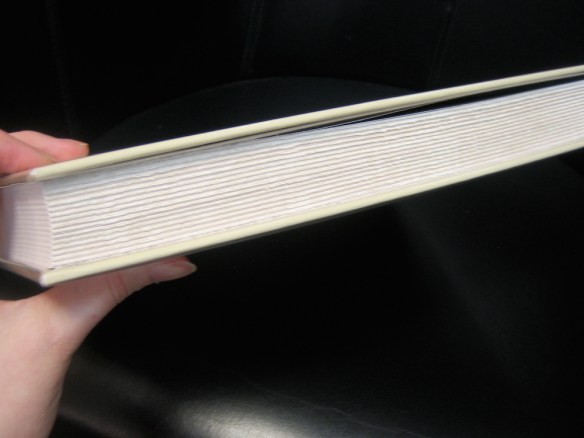
Edges.

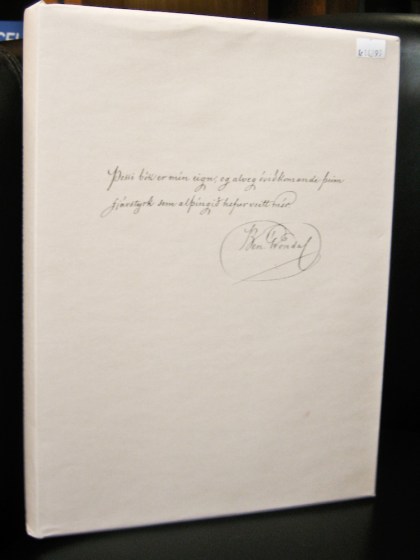
The regular version is awesome too. It comes packed in paper and on the front is written in Benedikt Gröndal’s handwriting: “This book is my property and has nothing to do with the financial aid given to me by the Parliament”. They left in a lot of his own writing and even used his original calligraphed title page. When his own handwriting wasn’t used, they use a typewriter font so it keeps with the old manuscript feel of the whole thing.

benediktgrondal-1

Lovely pattern.

benediktgrondal-3

List of birds.

benediktgrondal-5

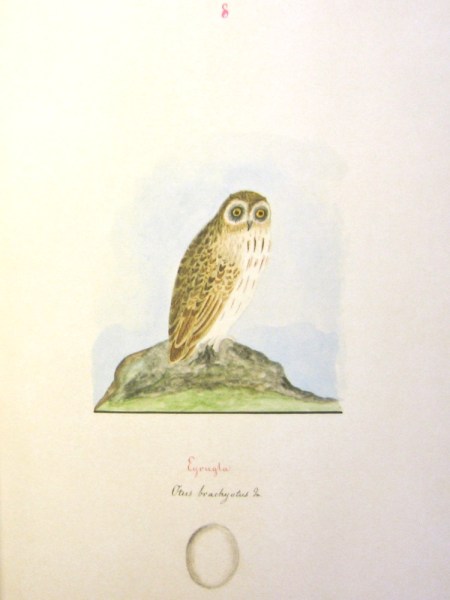
No more caffeine for this owl.

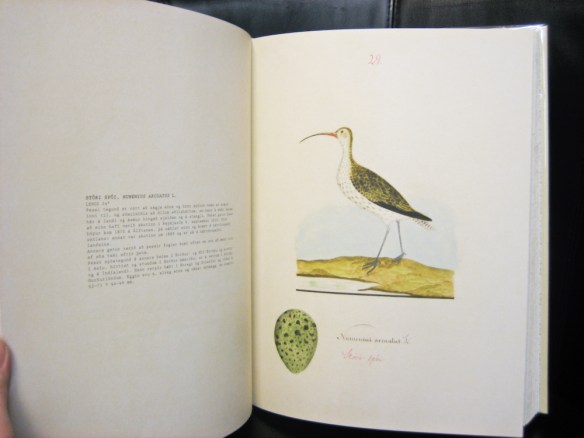
The drawings are brilliant. They’re obviously not quite what they do these days but you can just feel the passion and enthusiasm he had for nature. Benedikt Gröndal was definitely a pioneer in this area in Iceland. For this one guy to sit down and meticulously document not only birds but also plants and mammals at a time when Iceland was…well lets just say things were pretty shitty. Good job Crymogea for publishing this book.

benediktgrondal-7

The Great Auk. Extinct since the mid-19th century.

benediktgrondal-6

Eurasian Curlew.

Now when I decided to do this post I was quite optimistic about finding more brilliantly designed books published in Iceland in the past few years but I honestly came up a bit short. I must say the design of Icelandic book covers has improved dramatically in the last couple of years.

While desperately searching through Bókatíðindi I came across a couple of books whose popularity astounded me at the time. One such book is “Sumarlandið – framliðnir lýsa andláti sínu og endurfundum í framlífinu” or “Summerland – the deceased describe their death and reunions in the afterlife”. Yes that is the title and it sold out completely before christmas 2010, was reprinted in February 2011 and sold out again.

When it shot up the bestseller list in 2010 I remember briefly thinking that maybe we are a little bit weird as a nation. But it’s really not that surprising. We do have a reputation of readily believing all sorts of stuff. The book has a good message and was published by Guðmundur Kristinsson, a writer in his eighties who has quite a bit of experience in writing about these things. According to Bókatíðindi, it was published due to encouragement from beyond and when the dead encourage something I really do think it’s best to comply. And it all worked out. I’ll bet the big publishers were a bit annoyed at this surprise bestseller.

Another book that took me completely by surprise was “Og svo kom Ferguson…” or “And then came Ferguson”. It’s about Ferguson tractors in Iceland. When I first saw it I couldn’t help but wonder who would buy this book. Turns out lots of people did. If I remember correctly it also sold out before Christmas 2010 much to my amazement but in a cultural and historical context it all makes sense. Ferguson tractors were start of mechanisation in Icelandic agriculture. Before Ferguson tractors came to the country farmers used mostly people and small horses. As someone raised in the city what would I know about the importance of tractors? Interestingly enough a second book was published in 2011, this time about Farmall tractors.

Now I’d like to end this post on a low note because, why the hell not? The following is the worst book cover I’ve ever seen. It also came out in 2010 (clearly a weird year in publishing) and its name is Blowballs all over the place (it sounds even worse in English).

horror

Share the pain, that’s my motto.

Yes, those are naked people with blowballs (such a silly word) as heads. And yes, this book is real. When we opened the box containing this wonder we honestly didn’t know whether to laugh or cry. It’s just oh so bad.